China sends envoys to Eritrea and Ethiopia in push to head off another Horn of Africa war
Beijing's special envoys met President Isaias Afwerki and the foreign ministers of Ethiopia and Egypt. Analysts say China is walking a "thin line", and no formal negotiations have been announced.
By Eyob Hadgu · 24 November 2026
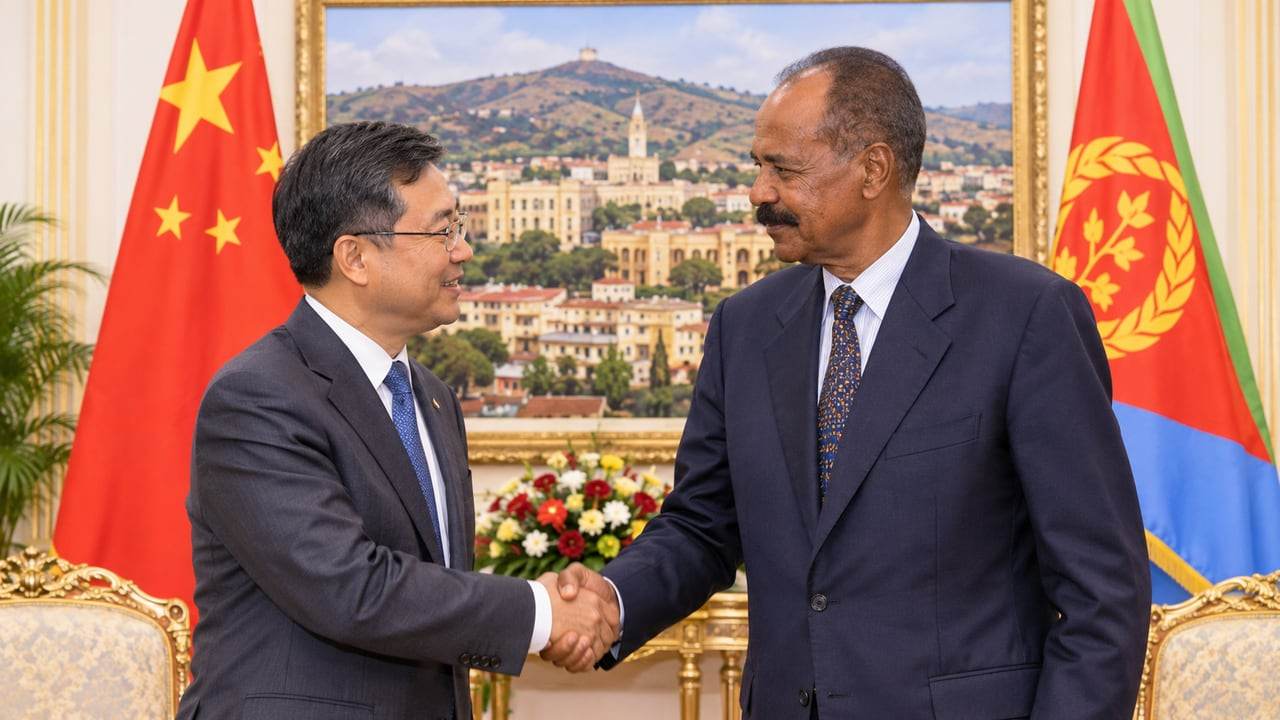
China's Horn of Africa envoy meets President Isaias Afwerki, shown in an illustration. (Illustration)
China has sent senior envoys to Eritrea, Ethiopia, Djibouti and Egypt in an effort to ease tensions that threaten to plunge the Horn of Africa into another conflict, Al Jazeera reported on 24 November.
Liu Xianfa, Beijing's special representative for African affairs, travelled to Ethiopia, Djibouti and Egypt in early November, while Hu Changchun, China's special envoy for Horn of Africa affairs, visited Eritrea. According to the report, they met senior officials including Eritrean President Isaias Afwerki and the foreign ministers of Ethiopia and Egypt.
Announcing the visits on 2 November, Chinese Foreign Ministry spokesperson Mao Ning said they were aimed at "promoting talks for peace, easing tensions, and playing a constructive role for upholding regional peace and stability".
The visits have produced statements of support for greater cooperation and regional peace, but no formal negotiations or concrete agreements have been announced, Al Jazeera said.
Why Beijing is involved
China has billions of dollars at stake in the region, which sits on one of the world's most important maritime trade routes. Between 2000 and 2023, China committed $17.8bn in loans to Ethiopia, according to the US-based research institute AidData, and its flagship projects include the $4.3bn Addis Ababa-Djibouti railway. Djibouti, near the Bab al-Mandeb strait, hosts China's first overseas military base, which opened in 2017.
"China is thus walking a thin line." — Edson Ziso, University of Adelaide
Edson Ziso, a visiting research fellow at the University of Adelaide, said all four countries are "critical to Beijing's economic and strategic interests", and that "China may need to look beyond its own interests in pursuit of concrete and sustainable de-escalation." He said Egypt's long-standing security ties with Washington could limit China's ability to achieve a breakthrough.
Zoon Ahmed Khan, a research fellow at the Beijing-based Center for China and Globalization, said Beijing's view is that "development gaps fuel instability", but that success depends on all parties accepting that "confrontation leaves all of them worse off".
The tensions
Ethiopia and Eritrea fought a border war from 1998 to 2000 that killed tens of thousands of people. A 2018 peace deal ended two decades of hostility, but relations began to unravel after the war in Tigray, in which Eritrean forces fought alongside Ethiopian government troops. Eritrea was excluded from the 2022 agreement that ended the main phase of that war.
Ethiopia has been landlocked since Eritrea's independence in 1993. Prime Minister Abiy Ahmed argues that sea access is essential for his country's future, and his government's interest in Eritrea's port of Assab has raised fears in Asmara over its sovereignty, Al Jazeera said. Both governments accuse each other of supporting armed groups.
Ethiopia is also in a long-running dispute with Egypt over the Grand Ethiopian Renaissance Dam on the Blue Nile, and Egypt has strengthened its relationship with Eritrea. Recent reports of Ethiopian and Eritrean troops gathering near their shared border have heightened fears of a wider conflict.
This report draws on reporting by Al Jazeera.
Get Asmara Post in your inbox every Thursday.
One weekly email. No spam, unsubscribe anytime.