Researcher compares Tigrayan forces' retreat from Mekelle to the EPLF's 1978 withdrawal to Nakfa
In an essay republished by Martin Plaut, Yohannes Woldemariam argues that Ethiopia's capture of Tigray's towns does not mean it has defeated the Tigray Defense Forces, and warns against another war between Ethiopia and Eritrea.
By Eyob Hadgu · 2 November 2026
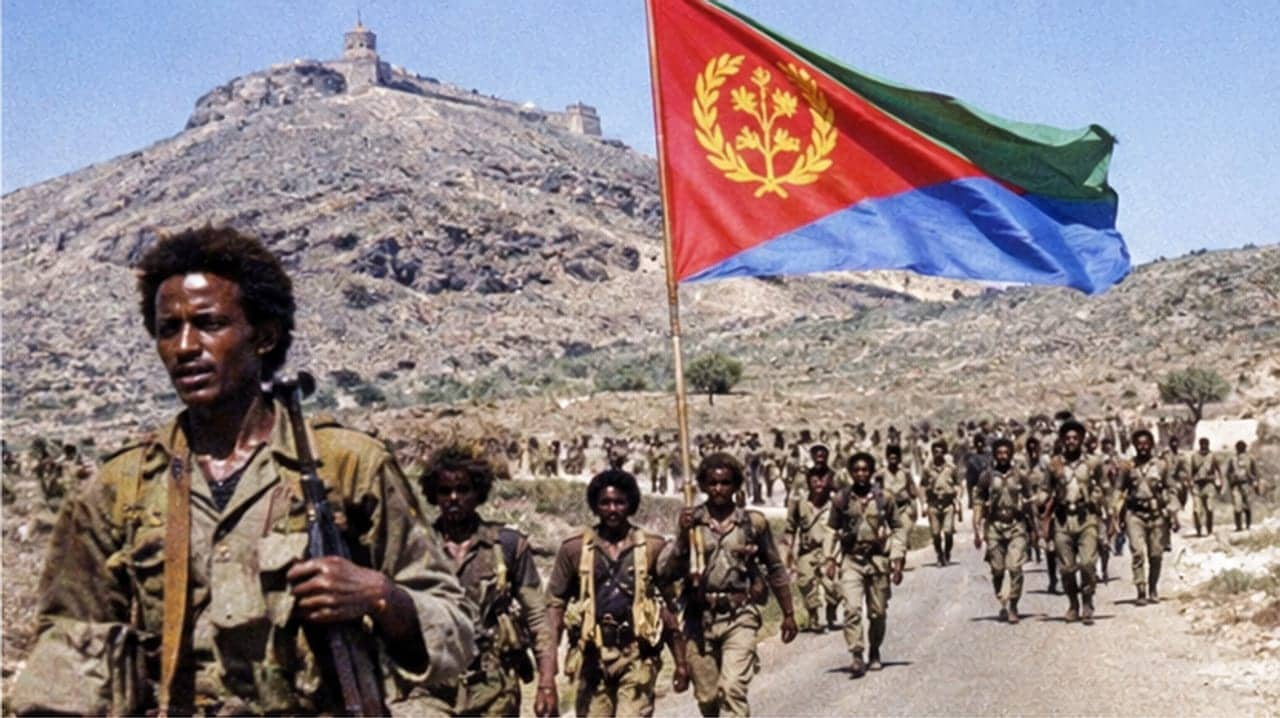
Eritrean liberation fighters on the march, shown in an illustration. The essay compares the TDF's withdrawal to the EPLF's 1978 retreat toward Nakfa. (Illustration)
The Tigray Defense Forces' (TDF) withdrawal from Mekelle and other towns should not be mistaken for a defeat, Horn of Africa researcher Yohannes Woldemariam argues in an essay first published by Pambazuka News on 29 October and republished on Martin Plaut's website on 1 November.
Woldemariam, an independent researcher with a PhD in international relations from the University of Massachusetts Amherst, writes that he believes the TDF will "ultimately prevail" against the imposition of federal military rule. He stresses that this is his "political and historical judgment, not a claim that war is popular or that its outcome is predetermined."
The Nakfa comparison
The essay's central argument draws on Eritrea's liberation war, a history he says "Eritreans of my generation know particularly well."
In 1977, he writes, the Eritrean People's Liberation Front (EPLF) and the Eritrean Liberation Front controlled much of the countryside and several important towns. In 1978, with large-scale Soviet military help and Cuban involvement, Mengistu's government launched a major counteroffensive. Rather than sacrifice its fighters defending every town, the EPLF pulled back toward the Sahel and consolidated its defences around Nakfa.
On a map, Woldemariam writes, Ethiopia's victories looked overwhelming. But the EPLF kept its organisation intact, built hospitals, workshops and schools in the mountains, and entered Asmara 13 years later. He argues that the Derg "could capture towns and maintain military garrisons, but it could not overcome the alienation produced by years of warfare and repression," and that Prime Minister Abiy Ahmed faces "a comparable contradiction in Tigray."
He also notes the limits of the comparison: the EPLF fought for independence, while the movements now cooperating against Abiy have different aims.
War fatigue and divided loyalties
The essay does not present Tigrayan support for renewed war as unconditional. Woldemariam cites a Human Rights Watch report of forced recruitment by Tigrayan authorities in 2026, which the TPLF leadership has denied, and warns that such practices risk alienating the families whose support sustained earlier struggles. He also points to Associated Press reporting that some former Tigrayan fighters were registering for disarmament.
He argues that the five officials Abiy appointed on 16 October to run Tigray were chosen by Addis Ababa rather than through a popular mandate, and that restoring services is "not the same as a durable political settlement."
What it says about Eritrea
Woldemariam calls the Eritrean government's 2020 decision to join the war against Tigray "a tragic decision," writing that Eritrean families lost sons and daughters in a conflict he does not believe was necessary to defend Eritrea's sovereignty.
He is equally firm that "Eritrea's sovereignty is not negotiable." Citing Reuters, he notes that Ethiopian troops entered the border town of Zalambessa on 13 October, and argues that Ethiopia's dependence on maritime trade does not give it the right to annex another country's coastline. Port access, he writes, can be negotiated, but "war and territorial annexation are not legitimate substitutes for diplomacy."
Background
Asmara Post has reported on federal forces' push toward the Eritrean border and the caretaker administration Addis Ababa installed in Tigray. Woldemariam's essay is an opinion piece. Several of its claims, including an allegation attributed to the TPLF's Debretsion Gebremichael that federal forces are using Mekelle's airport to move troops, are described in the essay itself as unverified.
This report draws on an essay by Yohannes Woldemariam, published by Pambazuka News and republished by Martin Plaut, which cites reporting by Reuters, the Associated Press and Human Rights Watch.
Get Asmara Post in your inbox every Thursday.
One weekly email. No spam, unsubscribe anytime.